
A warped board or a cluster of deep scratches doesn’t automatically mean your hardwood floors are finished. Most hardwood floors in Murfreesboro, TN, can be repaired, refinished, or partially replaced for a fraction of the cost of a full replacement — provided the damage is caught early and the subfloor is sound. Before assuming your floors need replacing, consider whether you can repair hardwood floor damage instead. Professional hardwood floor repair addresses everything from surface scuffs to individual damaged boards — and knowing how to repair hardwood floor scratches early prevents bigger issues later.
The right call comes down to four factors: the extent of the damage, the subfloor condition, the species and thickness of your existing wood, and how long you plan to stay in the home. In Middle Tennessee, those factors carry extra weight. Rutherford County’s high seasonal humidity and expansive clay soil put real, ongoing stress on hardwood — and what looks like surface damage is sometimes a symptom of a moisture or subfloor issue that sanding alone won’t fix.
Let’s take a look now at what local homeowners need to know about when to replace hardwood floors and when to simply refinish and repair them.
Key Takeaways
- Most hardwood floor damage is repairable — full replacement is only necessary in specific, identifiable situations.
- Surface damage (scratches, dents, fading) is fixed with a screen-and-recoat or a sand-and-refinish; structural damage (cupping, soft spots, separated boards) usually indicates a moisture or subfloor issue.
- A professional refinish runs $5 to $8 per sq. ft.; full hardwood replacement runs $8–$15 per sq. ft. installed.
- Replacement makes more sense when damage covers 30%+ of the floor, the wood is sanded down to the tongue-and-groove, or the subfloor needs to be rebuilt anyway.
- Murfreesboro’s humidity (70–80% in summer) and Rutherford County’s clay soil movement are common root causes of recurring floor problems — fixing the wood without fixing the moisture source is a temporary solution.
- A well-executed refinish often returns close to its full cost in resale value; full replacement typically returns 70–80%.
- The National Association of Realtors’ Remodeling Impact Report estimates that a well-executed hardwood floor refinishing has an ROI of nearly 150% — meaning it doesn’t just return its full cost; it returns roughly 1.5x.
Most homeowners can repair hardwood floor damage without a full replacement. If you’re wondering how to repair hardwood floor scratches, a screen-and-recoat or sand-and-refinish usually restores the surface — professional hardwood floor repair typically costs a fraction of installing new flooring.
HARDWOOD FLOOR DAMAGE: READING WHAT YOUR FLOORS ARE TELLING YOU
The type of damage you’re dealing with is the biggest factor in deciding your next step — surface problems and structural problems call for different responses. Professional hardwood floor repair services can often save you from a full replacement. If you’re set on replacing, knowing how to replace sections of a hardwood floor properly — rather than tearing up the whole room — keeps costs down while still giving your space a refreshed look.
Surface damage — scratches, scuffs, minor staining, UV fading, light dents — affects only the finish or the very top of the wood. A professional sand-and-refinish resolves this category almost entirely.
Structural damage points to something deeper:
- Cupping — board edges rise higher than the center
- Crowning — the center rises above the edges
- Deep cracks running through the plank thickness
- Soft spots that flex underfoot
- Separated boards pulling away from the subfloor
These conditions usually trace back to a moisture problem, a subfloor issue, or both. In Murfreesboro, clay soil expansion during wet seasons can shift slab and crawlspace foundations enough to cause cupping across an entire room — which is why a professional moisture and subfloor check should come before any repair decision.
Homeowners across Murfreesboro, TN, turn to local hardwood floor repair services before assuming they need to replace sections of their hardwood floors entirely. With Rutherford County’s humidity and shifting soil, a trusted local team can tell you what your floors actually need.
WHEN HARDWOOD FLOOR REPAIR IS THE RIGHT ANSWER
Wondering how to replace hardwood floors the right way? Start with a professional assessment. Hardwood floor repair services can determine whether you actually need to replace sections of the hardwood floor or if refinishing will restore the same worn-out look for less.
Repair is the right call more often than homeowners expect. If your floors are solid hardwood, at least ¾” thick, and the damage is localized rather than widespread, repair is almost always the more cost-effective and aesthetically sound option.
How to repair hardwood floor scratches:
- Light surface scratches → screen-and-recoat (lightly abrades the finish, applies a fresh topcoat, no wood removed)
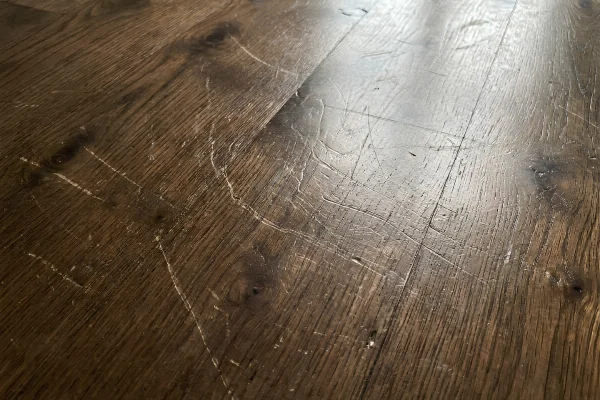
- Deeper scratches that reach the wood → full sand-and-refinish
- Solid hardwood can typically be sanded and refinished 5–10 times over its lifespan, depending on the remaining wear layer above the tongue-and-groove
How to replace a hardwood floor plank without replacing everything:
A single board with a deep gouge, an unsandable stain, or a crack through its thickness can usually be replaced individually. The process: remove the damaged plank, source matching wood, acclimate the new board to your home’s humidity for 5–7 days, then install, stain, and finish to match. In older homes with discontinued wood species, matching takes more sourcing effort but is usually achievable.
Cost comparison:
| Option | Cost per sq. ft. | Best for |
| Screen-and-recoat | Lower end of refinish pricing | Light surface scratches, no wood removal |
| Full sand-and-refinish | $2–$5 installed | Deeper scratches, dulled finish, overall wear |
| Individual plank replacement | Refinish cost + material/labor per board | Isolated deep damage, gouges, unsandable stains |
| Full hardwood replacement | $8–$15 installed | Widespread or structural damage (see below) |
For a 400 sq. ft. living room, the gap between a refinish and a full replacement can easily run into the thousands of dollars.
WHEN REPLACING HARDWOOD FLOORS MAKES MORE SENSE
Looking for hardwood floor refinishing near Murfreesboro or Smyrna or the neighboring communities? Local hardwood floor repair services are tailored for the local area, and our team of flooring experts understands how Middle Tennessee’s climate affects wood flooring. Our goal is to help homeowners make the best investment in their flooring.
Replacement is the smarter long-term investment when:
- The floor has been sanded down to or near the tongue-and-groove and can’t safely handle another refinish
- Damage covers more than 30% of the total floor area, making patch-matching impractical
- The subfloor has significant damage or moisture intrusion that requires a rebuild anyway
- The existing floor is engineered hardwood with a thin veneer — most engineered floors allow only one or two light sandings before the veneer is compromised, so significant damage often means engineered hardwood replacement rather than refinishing
Matching discontinued or rare wood species: In Murfreesboro homes built in the 1970s–90s, some species and stain combinations are no longer in production. When damage is extensive and a seamless match isn’t realistic, replacing the whole floor — often with a wider plank or more modern finish — is usually the cleaner outcome.
THE ROLE OF HUMIDITY AND SUBFLOOR CONDITIONS IN MIDDLE TENNESSEE
Wood is hygroscopic — it absorbs and releases moisture from the surrounding air. That makes Tennessee’s climate a real factor in how long any repair or replacement actually lasts.
- Humidity: Murfreesboro summer relative humidity regularly reaches 70–80%. Uncontrolled indoor humidity causes hardwood to swell, cup, and buckle. The ideal indoor range is 30–50% year-round.
- Maintained with a properly sized HVAC system and/or a whole-house dehumidifier. Before any repair or refinish, bring the home to that range and hold it for at least two weeks — this shows how much damage resolves through drying alone versus how much needs physical repair.
- Subfloor and soil movement: Rutherford County sits on expansive clay soil that shifts as it absorbs and releases water seasonally, creating high and low spots that translate into uneven, creaking, or separating hardwood above. Industry standard allows no more than 3/16″ of variation over a 10-ft span — anything beyond that needs grinding or leveling compound before new wood goes down.
Skipping either of these checks is one of the most common reasons hardwood floors in this region develop problems again within a few years of installation. Hardwood floor refinishing is often overlooked before homeowners decide to replace hardwood floors entirely. Local hardwood floor repair services can walk you through how to replace hardwood floors when it’s truly needed — and when a refinish will do the job just as well.
HARDWOOD FLOOR REPAIR AND REFINISHING: PROFESSIONAL VS. DIY
| Item | DIY-appropriate | Professional required |
| Scope | Small, isolated surface scratches | Sanding, refinishing, plank replacement, stain matching |
| Tools | Touch-up markers, wax fill sticks, scratch-concealing products | Drum sanders, commercial-grade finishes |
| Risk | Low — concealment only, not restoration | High if attempted without experience — sanded-through wear layers, swirl marks, uneven finish are difficult or impossible to correct |
| Typical case | Single plank replacement in a floating floor system | Nail-down/glue-down installs, any full-room refinish, color/stain matching. |
Drum sanding and stain matching are the two areas where professional experience matters most — an inexperienced pass can remove too much wood or produce a visibly inconsistent color across a room, and both mistakes are costly to fix. For anything beyond a small touch-up, professional work is almost always worth the cost given how much of the home’s value hardwood represents.
PROPERTY VALUE AND RETURN ON INVESTMENT
Hardwood floors are consistently one of the top features home buyers look for, and homes with well-maintained hardwood tend to sell faster and at higher prices than comparable homes with carpet or visibly damaged flooring.
| Approach | Typical ROI at resale | Notes |
| Professional refinish | Near 100% of cost, sometimes more in competitive markets | Fastest, least disruptive, highly visible during showings |
| Full replacement (quality solid hardwood) | 70–80% of cost | Still a strong return; installation quality is the key variable |
For homeowners in La Vergne or Christiana, TN preparing to list, a targeted refinish of existing hardwood is often the highest-return move available before putting the home on the market.
Choosing a finish for durability:
- Oil-modified polyurethane — traditional, warm amber tone that deepens with age
- Water-based polyurethane — dries faster, stays clearer, best for lighter wood species where color accuracy matters
- Hard-wax oil — natural appearance, popular in Middle Tennessee, allows spot-repair without refinishing the whole floor
GET QUALITY HARDWOOD FLOOR REFINISHING TODAY
If your hardwood floors are showing wear, damage, or movement and you’re not sure whether repair or replacement is the right move, a professional assessment is the fastest way to a straight answer.
Flooring Murfreesboro offers free in-home flooring estimates throughout Murfreesboro, Smyrna, La Vergne, Christiana, and the surrounding Rutherford County, TN area. We’ll evaluate your existing floors, check subfloor conditions, assess moisture levels, and tell you plainly whether repair, refinishing, or replacement is right for your situation and budget.
Learning how to repair scratches in hardwood flooring starts with identifying the depth of the damage. Light marks respond to a simple recoat, while deeper ones need sanding. In most cases, hardwood floor repair is faster and cheaper than homeowners expect. Contact us today to schedule your free in-home consultation, or stop by our local showroom to see our full selection of hardwood species, finishes, and flooring options in person.
FREQUENTLY ASKED QUESTIONS
Can you repair a damaged hardwood floor?
Yes — most damaged hardwood can be repaired. Surface scratches respond to a screen-and-recoat or sand-and-refinish; individual boards with serious damage can be replaced and matched. The floor just needs a sound subfloor and enough wear layer left for sanding.
Is it cheaper to repair or replace hardwood floors?
Repair is almost always cheaper. Refinishing runs $2–$5 per sq. ft. versus $8–$15 per sq. ft. for full replacement. Replacement only becomes more cost-effective when damage is widespread, or the subfloor needs extensive work anyway.
Can you replace one plank in the hardwood floor?
Yes, this is a standard repair. A pro removes the damaged board, sources a matching replacement, acclimates it 5–7 days, then installs, stains, and finishes it to blend with the surrounding floor.
When should you replace hardwood floors instead of repairing them?
Replace when the wear layer is sanded too thin for another refinish, damage covers more than 30% of the floor, or there’s significant subfloor damage or persistent moisture intrusion that repair alone won’t solve.
How does Middle Tennessee’s humidity affect hardwood floors?
Summer humidity often exceeds 70%, causing wood to absorb moisture and cup, gap, or squeak. Keeping indoor humidity between 30–50% year-round with proper HVAC or a dehumidifier is the most effective long-term protection.
How much does it cost to refinish hardwood floors in Murfreesboro, TN?
Most professional refinishing jobs run $5 to $8 per sq. ft., depending on floor condition and the number of finish coats needed. A 400 sq. ft. room typically falls in the low-to-mid four figures.
Can water-damaged hardwood floors be repaired?
Often, yes — if the damage is caught early and limited to a few boards. Widespread water damage, warping, or mold usually requires replacing the affected section and addressing the moisture source first.
How long does hardwood floor refinishing take?
A typical room takes 3–5 days, including sanding, staining, and multiple coats of finish, plus drying time between coats. Larger homes or oil-based finishes can extend the timeline.
Do you need to move out during hardwood floor refinishing?
Not usually, but the refinished rooms are off-limits until the finish cures — typically 24–72 hours to walk on, longer before moving furniture back. Dust containment and odor also factor into comfort during the job.
How often should hardwood floors be refinished?
Most solid hardwood needs refinishing every 7–10 years depending on traffic and wear, though light-traffic areas can go longer. Engineered hardwood needs it less often but tolerates fewer refinishes overall.
Can engineered hardwood floors be repaired the same way as solid hardwood?
Not exactly. Engineered hardwood has a thin veneer layer that typically allows only one or two light sandings before it’s compromised, so significant damage often calls for replacement rather than repeated refinishing.
Is it worth replacing hardwood floors before selling a house?
Usually not, if the existing floor is repairable — a refinish returns close to its full cost and shows just as well to buyers. Full replacement is worth it mainly when the floor is damaged beyond repair or is an outdated species that hurts the home’s appeal.